As renewable energy projects continue to expand across Ireland, one challenge remains common on many sites: how do you provide reliable temporary power before a permanent grid connection is available?
That was the challenge facing a large-scale solar farm development in Ballinasloe, Co. Galway. During the commissioning phase of the project, power was required for the newly constructed substation and essential site infrastructure. However, with no ESB mains connection available, the project team needed an efficient and dependable temporary power solution.
Rather than relying on a traditional diesel generator running continuously around the clock, MW Hire delivered a hybrid power solution that dramatically reduced fuel consumption, operating costs, carbon emissions, and generator runtime.
The Challenge: Temporary Site Power Without Grid Access
Temporary power is a critical requirement on solar farms, substations, infrastructure developments, utility projects, and remote construction sites. Historically, diesel generators have been the default choice for supplying site power while waiting for a permanent connection.
The problem is that site loads are often difficult to predict during the early stages of a project. To ensure sufficient capacity, generators are frequently oversized, resulting in poor fuel efficiency, excessive idling, higher servicing requirements, and unnecessary carbon emissions.
At the Ballinasloe site, the average power demand was relatively low, ranging between 5kW and 8kW, but this load was required continuously, 24 hours a day, seven days a week. Running a diesel generator alone under these conditions would have resulted in significant fuel consumption and ongoing operational costs.
The Solution: Hybrid Power Using Battery Storage and Generator Backup
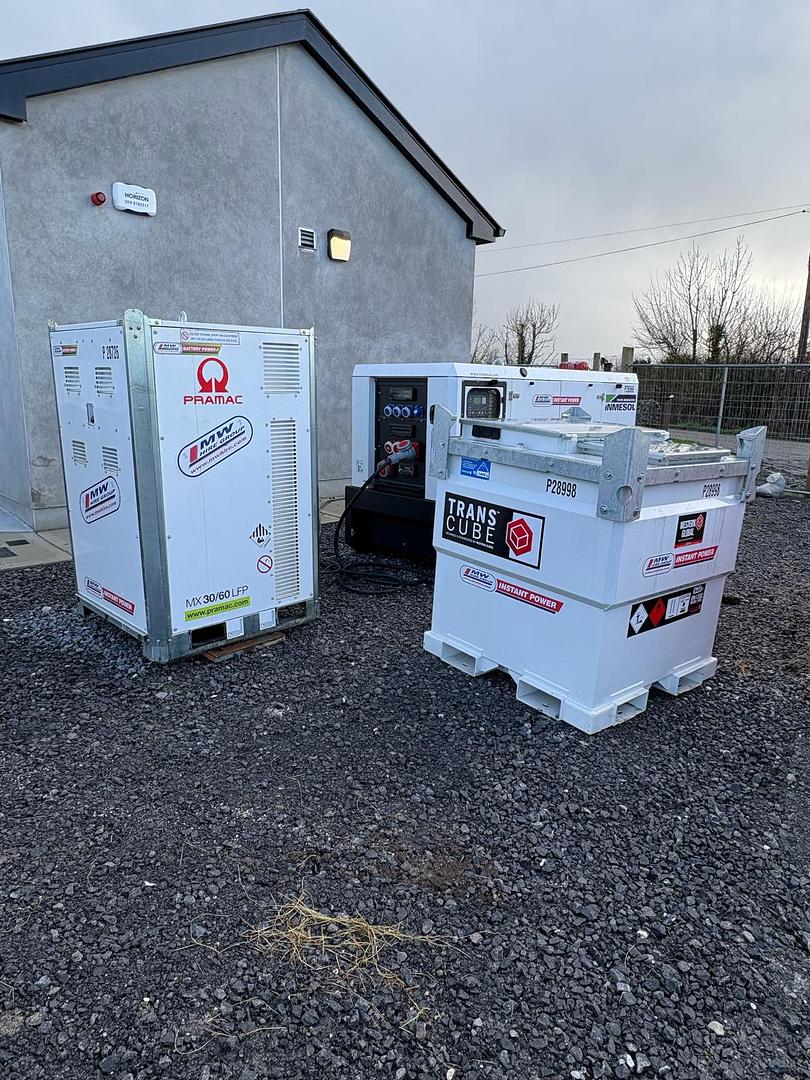
To improve efficiency and sustainability, MW Hire designed and supplied a hybrid temporary power system consisting of:
- Pramac MX30/60 Battery Energy Storage System (BESS)
- Inmesol IIR066 Silent Diesel Generator
- 1,000-litre Bunded Fuel Cube
The battery energy storage system carried the site's base load requirements while the generator operated only when necessary to recharge the battery system and support demand peaks. This approach allowed the site to maintain uninterrupted power while significantly reducing generator operating hours.
Hybrid power systems such as this are increasingly being adopted across the construction, utilities, renewable energy, and infrastructure sectors as companies seek to lower fuel consumption and reduce environmental impact without compromising reliability.
February 2026 Results: 81% Reduction in Generator Runtime
The results from the first full month of operation demonstrated the effectiveness of the hybrid solution.
February Site Performance
- Days on site: 28
- Total hours: 672
- Traditional generator runtime: 672 hours
- Actual generator runtime: 124.57 hours
- Reduction in generator running hours: 81%
- Fuel cost using a traditional generator: €5,376
- Actual fuel cost using BESS hybrid system: €999.73
- Fuel savings: €4,376
- CO₂ reduction: 11,553kg
By reducing runtime from 672 hours to just 124.57 hours, the hybrid setup delivered substantial fuel savings while dramatically lowering emissions and wear on the generator.
March 2026 Results: Generator Runtime Reduced by 85%
Performance improved even further during the first 19 days of March.
March Site Performance (1st-19th March)
- Days on site: 19
- Total hours: 456
- Traditional generator runtime: 456 hours
- Actual generator runtime: 68.57 hours
- Reduction in generator running hours: 85%
- Traditional fuel cost: €4,742
- Actual fuel cost with BESS: €717.11
- Fuel savings: €4,025
- CO₂ reduction: 8,174kg
These results highlight how battery storage can deliver even greater efficiencies as site load profiles become established and system performance is optimised.
Total Project Savings Over the 47-Day Study Period
Combining the February and March data provides a clear picture of the overall impact.
Economic Benefits
Across the 47-day study period:
- Traditional fuel cost: €10,118
- Actual fuel cost using BESS hybrid solution: €1,716.84
- Fuel savings achieved: €8,401.16
- Total hire and fuel cost saving: €5,485.24 compared with a conventional generator-only approach.
Environmental Benefits
- Total CO₂ reduction: 19,727kg
- Estimated annualised CO₂ saving: 153,199kg
Operational Benefits
- Traditional generator runtime: 1,128 hours
- Actual generator runtime: 194 hours
- Runtime reduction: 934 hours
- Estimated annualised reduction: 7,253 generator operating hours
Reducing generator runtime not only cuts fuel costs but also lowers servicing requirements, extends equipment lifespan, reduces downtime risk, and improves overall site efficiency.
Why Battery Energy Storage Makes Sense for Temporary Site Power
This Ballinasloe solar farm project demonstrates how battery energy storage systems are transforming the way temporary power is delivered on modern construction and renewable energy sites.
For projects with relatively low continuous loads, running a diesel generator around the clock is often inefficient and costly. A hybrid battery storage solution allows generators to operate only when needed, delivering substantial reductions in fuel consumption, emissions, noise pollution, and maintenance requirements.
The quieter operation also provides an important benefit for sites located near residential areas, helping minimise disruption and reduce complaints from nearby communities.
Looking for a Temporary Power Solution?
Whether you're managing a solar farm, substation project, utility installation, infrastructure development, or remote construction site, hybrid power systems can significantly reduce the cost and environmental impact of temporary energy supply.
The Ballinasloe project demonstrates that combining a Battery Energy Storage System with a correctly sized generator can deliver major operational improvements while achieving substantial cost savings and carbon reductions.
If you're planning a project that requires reliable temporary power before grid connection, MW Hire can help design a tailored solution that reduces fuel usage, improves sustainability, and keeps your project running efficiently from day one.